

THIS POST MAY CONTAIN AFFILIATE LINKS. PLEASE SEE MY DISCLOSURES. FOR MORE INFORMATION.
There’s a good chance you already have one of the most useful household products sitting in your kitchen cabinet.
And it probably cost you only a few dollars.
Plain white vinegar is good for a lot more than making salad dressing and pickles.
That inexpensive bottle can help tackle hard-water buildup, freshen laundry, clean grimy appliances, remove stubborn stickers, trap fruit flies, and solve all kinds of little household annoyances.
The trick is knowing where vinegar actually works, and where you definitely shouldn’t use it.
Some of the vinegar tricks passed around online are genuinely useful.
Others are ineffective, unnecessary, or potentially damaging to the very thing you’re trying to clean.
So rather than throwing vinegar on everything in sight, here are some of the best ways to put it to work around your home, along with a few important precautions that could save you an expensive mistake.
Before You Start: Vinegar Doesn’t Belong Everywhere
Vinegar may be natural, but that doesn’t mean it’s safe for every cleaning job.
Its acidity is exactly what makes it useful for dissolving certain mineral deposits and grime, but that same acidity can damage some materials and finishes.
Never mix vinegar with chlorine bleach. Combining the two can release dangerous chlorine gas.
You should also avoid automatically reaching for vinegar on natural stone such as marble, limestone, and travertine; waxed or specially finished surfaces; electronic screens and devices; and anything whose manufacturer specifically warns against acidic cleaners.
Some grout, flooring, appliance components, and specialty surfaces can also be damaged by repeated exposure.
When you’re unsure, check the manufacturer’s cleaning instructions first.
And when trying vinegar on a new surface, test a small, inconspicuous area before tackling the whole thing.
One more thing: unless a tip specifically calls for something else, the vinegar we’re talking about in this article is ordinary distilled white vinegar, not industrial-strength cleaning vinegar.
With that out of the way, let’s put that cheap bottle in the pantry to work.
1. Descale Your Coffee Maker
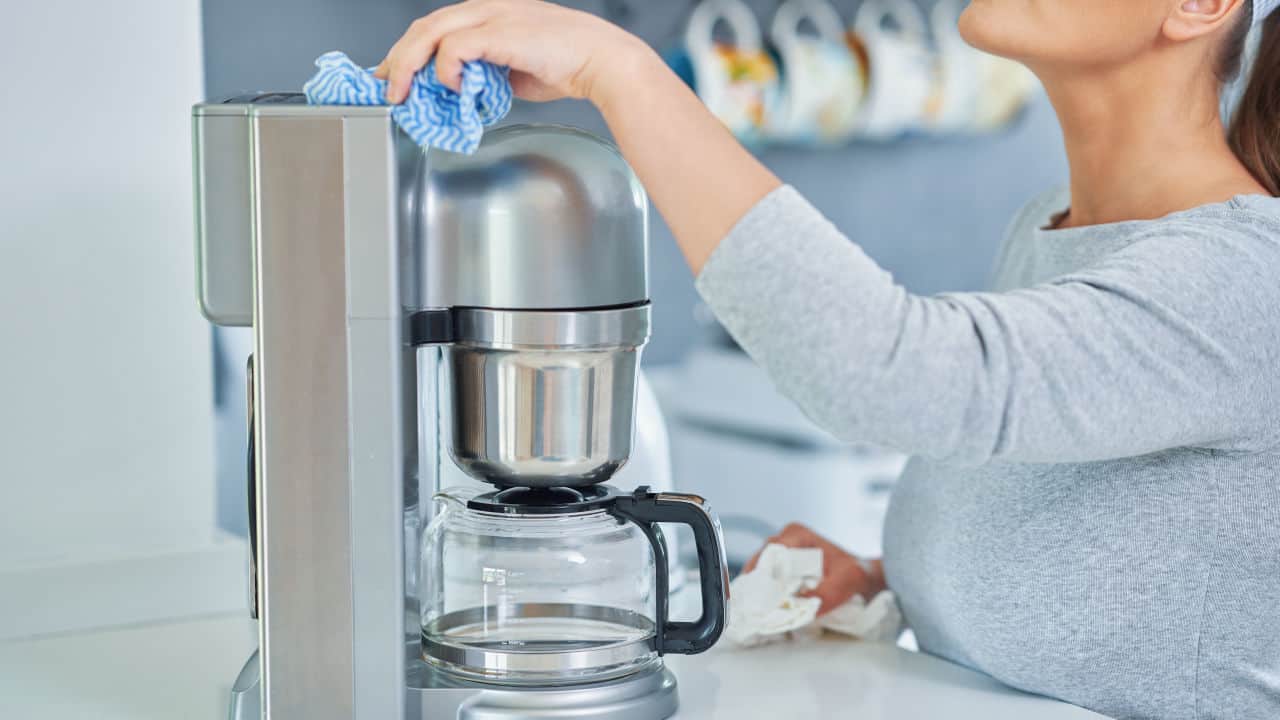
If your coffee maker suddenly seems slower than it used to be, the machine may not be dying.
Mineral deposits from your water can gradually build up inside it, restricting water flow and affecting how well it brews.
White vinegar can help dissolve that mineral buildup, but check your coffee maker’s manual before pouring vinegar into the reservoir.
Some manufacturers recommend vinegar for descaling, while others specify a particular descaling solution or procedure.
If vinegar is approved for your machine, follow the manufacturer’s recommended amount and descaling steps rather than guessing at a vinegar-to-water ratio.
Afterward, run the required fresh-water rinse cycles so you don’t end up with tomorrow morning’s coffee tasting suspiciously like salad dressing.
This is especially worth remembering if your machine is taking longer to brew, making unusual noises, or hasn’t been descaled in quite a while.
Good to know: This tip is for traditional coffee makers that allow vinegar descaling. Don’t assume the same method is safe for every pod machine, espresso machine, or specialty brewer.
2. Remove Hard-Water Buildup From a Showerhead
If your showerhead has started spraying in every direction, or a few of the holes barely spray at all, the problem may be mineral buildup rather than bad water pressure.
For showerheads that can safely be cleaned with vinegar, fill a sturdy plastic bag with enough distilled white vinegar to cover the clogged spray holes.
Slip the bag over the showerhead and secure it so the affected area sits in the vinegar.
After soaking, remove the bag, gently scrub loosened deposits with an old toothbrush, rinse thoroughly, and run the shower for a minute.
The vinegar’s acidity helps loosen the calcium and other mineral deposits that accumulate when water repeatedly dries on the fixture.
Good to know: Check the manufacturer’s cleaning instructions first, especially with brass, nickel, gold-tone, stone, or other specialty finishes. Don’t assume an overnight vinegar soak is better. Extended exposure can damage some finishes and components.
3. Get Rid of That White Crust Around Your Faucets
You know that stubborn, chalky white ring that forms around the base of a faucet?
You can scrub at it forever and still feel like you’re accomplishing absolutely nothing.
That’s because it may be hard-water mineral buildup, and this is one of the jobs where vinegar can be genuinely useful.
If vinegar is safe for your faucet’s finish, soak a cloth or paper towel in distilled white vinegar and wrap it around the mineral-crusted area.
Let it sit briefly to give the vinegar time to loosen the deposits, then remove the cloth and gently wipe or scrub the area with a soft toothbrush.
Rinse thoroughly with water and dry afterward.
For stubborn buildup, you may need to repeat the process rather than attacking the faucet with an abrasive scrubber.
Good to know: Be cautious with natural stone countertops surrounding the faucet. Vinegar can etch marble, limestone, travertine and other acid-sensitive stone, so don’t let it drip or pool on those surfaces.
4. Rescue Cloudy Drinking Glasses
If your drinking glasses come out of the dishwasher looking foggy instead of sparkling, don’t assume they’re permanently ruined.
Sometimes that cloudy film is caused by hard-water minerals left behind on the glass.
To find out, dampen a soft cloth with distilled white vinegar and rub a small cloudy area.
If the spot clears up, mineral buildup is probably the culprit.
For vinegar-safe glassware, soak the affected glasses in a mixture of white vinegar and warm water, then gently wipe them with a nonabrasive sponge or cloth. Rinse thoroughly and dry with a lint-free towel.
It’s an easy trick that can make old glasses look surprisingly good again.
Good to know: Vinegar can’t repair glass that has been permanently etched. If the cloudiness doesn’t improve when you test it with vinegar, repeated soaking probably isn’t going to help, and aggressive scrubbing may only make matters worse.
5. Freshen Towels That Have Started Feeling Stiff

Towels have a strange life cycle.
They’re wonderfully soft when you buy them, and then one day you realize you’re drying yourself with something that feels suspiciously like a welcome mat.
One possible culprit is detergent, fabric-softener, and mineral buildup trapped in the fibers.
If your towel’s care instructions allow it, adding distilled white vinegar to the rinse cycle can help remove some of that residue.
Use the amount recommended by your washing-machine manufacturer, and put it in the appropriate dispenser rather than pouring it directly onto the fabric.
Skip the fabric softener for that load, since softeners can leave coatings on towel fibers and reduce absorbency.
Good to know: Don’t make vinegar an automatic addition to every load. Washing machine manufacturers vary in their recommendations because repeated exposure to acid may affect certain rubber seals and components. Check your machine’s manual before making this a regular habit.
6. Clean Mineral Buildup From a Tea Kettle
That chalky layer inside a kettle isn’t necessarily dirt.
If you have hard water, it’s often limescale, mineral deposits left behind as water is heated and evaporates.
For kettles whose manufacturer permits vinegar descaling, add a diluted mixture of distilled white vinegar and water according to the manufacturer’s directions.
Let the solution work for the recommended amount of time, then empty the kettle and rinse it thoroughly several times with fresh water.
For an electric kettle, always follow its specific descaling instructions rather than submerging it or getting electrical components wet.
This is one of those chores that’s easy to forget because you normally don’t see inside the kettle, until you finally look and wonder how you’ve apparently been boiling water in a tiny limestone cave.
Good to know: Never assume vinegar is approved for every kettle. Different metals, coatings, heating elements and warranties can require different descaling methods.
7. Remove Stickers and That Annoying Sticky Residue
Getting the sticker off is usually the easy part.
It’s the gummy patch left behind that makes you regret ever buying something with a price tag on it.
For vinegar-safe surfaces such as many types of glass, soak a cloth or paper towel with distilled white vinegar and press it against the leftover adhesive for several minutes.
The vinegar can help soften the residue so you can gently work it away with the cloth or a plastic scraper.
For particularly stubborn adhesive, repeat the process rather than reaching for a razor blade or aggressive scrubber that could scratch the surface.
This can be especially handy for jars you want to reuse after removing their labels.
Good to know: Test first on painted, finished, plastic, wood, or other delicate surfaces. Vinegar isn’t universally safe, and some adhesives respond better to other removal methods.
8. Steam Away Dried-On Microwave Messes
There’s always that one mysterious splatter inside the microwave that somehow turns into concrete before anyone notices it.
Instead of immediately attacking dried food with a scrubber, use steam to soften it first.
Place a microwave-safe bowl containing water and a small amount of distilled white vinegar inside the microwave.
Heat it until the mixture is steaming, then turn the microwave off and leave the door closed for several minutes.
The trapped steam helps loosen dried-on food, making the interior much easier to wipe clean with a damp cloth.
Remove the bowl carefully.
It and the liquid can be extremely hot. Then wipe the interior rather than spraying cleaner directly into vents or openings.
Good to know: The steam is doing much of the heavy lifting here. You don’t need an enormous amount of vinegar, and you certainly don’t need to boil a bowl of straight vinegar.
9. Make a Simple Fruit Fly Trap
A bowl of fruit on the counter can go from charming kitchen decor to fruit-fly convention center remarkably quickly.
Apple cider vinegar makes a useful bait because its fermented smell attracts fruit flies.
Pour a small amount into a jar or glass, add a drop of dish soap, and leave it near the area where you’re seeing the flies.
The dish soap reduces the liquid’s surface tension, making it harder for flies that land on it to escape.
You can also cover the container with paper fashioned into a funnel or plastic wrap with a few small holes, although the vinegar-and-soap version is wonderfully simple.
More importantly, remove the source of the infestation.
Check overripe produce, recycling, garbage and other places where fruit flies may be breeding.
Otherwise, you’re trapping some while providing a nursery for the next generation.
Good to know: Apple cider vinegar is the better choice for this particular trick because the aroma is part of what attracts the flies.
10. Clean Mineral Deposits From Terra-Cotta Pots
Those chalky white patches that develop on terra-cotta flowerpots can make relatively new pots look ancient.
The residue is often caused by soluble salts and minerals that migrate through the porous clay as water evaporates.
When you’re cleaning an empty pot between plantings, vinegar can help loosen stubborn mineral deposits.
Brush away loose dirt first.
Then use diluted distilled white vinegar on the affected areas and scrub gently with a stiff brush.
Rinse the pot extremely well afterward and allow it to dry before using it again.
It’s particularly satisfying on older terra-cotta pots because you can actually see the original clay color emerging as the crust comes away.
Good to know: Don’t start pouring vinegar into planted pots. Vinegar is acidic and can damage plants and alter conditions in the soil. This trick is for empty pots being cleaned for reuse.
11. Keep Cut Flowers Fresh a Little Longer

A grocery-store bouquet can brighten up a room, right up until the water turns cloudy and the flowers start drooping three days later.
One old-fashioned trick is adding a small amount of distilled white vinegar and sugar to the vase water.
The sugar provides carbohydrates for the cut flowers, while the acidic environment can help make conditions less favorable for some microbial growth.
Start with a thoroughly clean vase, trim the stems as appropriate for the flowers, and remove any leaves that would sit below the waterline.
Then add the vinegar and sugar to fresh water and stir until the sugar dissolves.
The bigger secret, though, is maintenance: change the water regularly and clean the vase rather than continually topping off murky water.
Good to know: Different flowers have different care requirements, and packets of commercial flower food are specifically formulated for the job. If your bouquet came with one, use it according to the directions rather than improvising.
12. Clean a Removable Faucet Aerator
If the water coming from your faucet suddenly sprays sideways, flows unevenly, or seems weaker than it used to, you might not need a plumber, or even a new faucet.
Check the aerator, the little screen assembly at the end of many faucets.
Hard-water minerals can gradually clog its tiny openings.
If your faucet manufacturer permits vinegar cleaning, carefully remove the aerator, keeping track of how its small pieces fit together.
Soak the vinegar-safe components in distilled white vinegar long enough to loosen the mineral deposits, then gently brush away anything remaining with an old toothbrush.
Rinse everything thoroughly and reinstall it.
It’s a remarkably satisfying little fix when the water starts flowing normally again.
Good to know: Aerators contain small screens, washers and other parts that are easy to lose. Also check the manufacturer’s instructions before soaking anything with a specialty finish.
13. Use Vinegar to Help Poached Eggs Hold Together
Here’s one that has nothing to do with cleaning.
If your homemade poached eggs tend to turn into wispy underwater jellyfish, a little vinegar in the cooking water can help.
Adding a small amount of vinegar to gently simmering water lowers the pH and helps the proteins in the egg white coagulate more quickly.
That can help the white set around the yolk instead of spreading quite as dramatically through the pan.
You don’t need enough vinegar to make the egg taste sour.
A modest splash in a saucepan of water is plenty.
Fresh eggs also tend to poach more neatly because their whites are naturally firmer.
Crack the egg into a small bowl first, then gently slide it into the simmering water rather than cracking it directly over the pot.
Good to know: This isn’t mandatory for poached eggs. It’s simply a useful little assist, particularly when your eggs aren’t extremely fresh.
14. Make a Quick Buttermilk Substitute for Baking
You’re halfway through making pancakes.
The dry ingredients are mixed. The pan is heating.
Then you discover the buttermilk carton contains approximately three drops.
Vinegar can rescue the situation.
For recipes where acidified milk is an acceptable substitute for buttermilk, put 1 tablespoon of distilled white vinegar into a measuring cup and add enough milk to reach 1 cup.
Stir it and let it stand for about 5 to 10 minutes before using it.
The acid is particularly useful in recipes containing baking soda because that acid-base reaction helps produce carbon dioxide, which contributes to leavening.
It’s handy for pancakes, muffins, quick breads and similar recipes when a trip to the grocery store sounds considerably less appealing than improvising.
Good to know: This doesn’t perfectly duplicate cultured buttermilk’s flavor, thickness or microbial culture. For recipes where genuine buttermilk is central to the finished product, the real thing is still preferable.
15. Turn Leftover Vegetables Into Quick Refrigerator Pickles
That half an onion, lonely cucumber, or handful of carrots in the refrigerator doesn’t necessarily have to become compost.
You can turn many vegetables into quick refrigerator pickles using a vinegar-based brine.
Unlike shelf-stable canned pickles, refrigerator pickles are designed to stay refrigerated.
Cucumbers are the obvious choice, but red onions, carrots, radishes and other vegetables can also work beautifully.
Depending on the recipe, the brine might contain vinegar, water, salt, sugar and seasonings such as peppercorns, garlic or herbs.
This is one of my favorite vinegar tricks because it actually turns something you might have thrown away into something you’ll deliberately put on sandwiches, tacos, salads and burgers.
Good to know: Don’t improvise vinegar ratios for shelf-stable canning. Safe home canning requires a tested recipe with the specified type and acidity of vinegar. Refrigerator pickles are a different process and should remain refrigerated.
16. Get Soap Scum Off Glass Shower Doors
Glass shower doors have an impressive ability to look sparkling clean for approximately twelve minutes.
The cloudy film that develops is often a combination of soap residue and hard-water minerals, which is why distilled white vinegar can be useful.
If vinegar is safe for your shower’s materials and finishes, apply it to the glass and give it a little time to work before wiping with a nonabrasive sponge or microfiber cloth.
Rinse thoroughly and use a squeegee to finish.
For heavier buildup, several gentle applications are preferable to attacking the glass with something abrasive.
Once you’ve gotten the doors clean, using a squeegee after showers can slow down the next round of buildup considerably.
Good to know: Keep vinegar away from nearby marble, travertine, limestone and other acid-sensitive natural stone. Also check the shower door manufacturer’s instructions if the glass has a special protective coating.
17. Make Windows and Mirrors Sparkle Without a Specialty Cleaner
You probably don’t need a cabinet full of different bottles to deal with ordinary fingerprints and grime on household glass.
For plain, uncoated windows and mirrors, a diluted solution of distilled white vinegar and water can make an inexpensive glass cleaner.
Lightly apply it to the glass, then wipe with a clean microfiber cloth or use a squeegee on larger windows.
One of the biggest secrets to streak-free glass isn’t actually the vinegar, it’s avoiding too much cleaner and using a genuinely clean cloth.
A microfiber cloth that’s already carrying detergent, fabric softener, grease, or yesterday’s cleaning product can simply move residue around.
For exterior windows, tackle them when the glass isn’t blazing hot in direct sunlight.
Cleaner that dries almost immediately is much harder to wipe evenly.
Good to know: Don’t assume homemade vinegar cleaner is appropriate for tinted, coated, treated, or specialty glass. Follow the manufacturer’s instructions for those surfaces.
18. Deodorize a Smelly Garbage Disposal

Sometimes the kitchen is perfectly clean and yet there’s still a mysterious smell hanging around the sink.
The garbage disposal may be responsible.
Food residue can collect inside the disposal and around the rubber splash guard, creating odors that don’t disappear just because you’ve run some water.
If your disposal manufacturer permits vinegar, it can be used as part of an occasional cleaning routine.
Turn the disposal off before cleaning any accessible exterior or splash-guard surfaces, and never put your hand down inside the disposal.
Clean the removable or safely accessible components according to the manufacturer’s directions.
A small amount of diluted vinegar may help with odors and mineral residue where approved.
For routine use, plenty of cold running water before, during, and after grinding food can also help reduce buildup.
Good to know: Vinegar isn’t a substitute for removing trapped food or fixing a plumbing problem. If the odor keeps returning, there’s probably a source that needs to be physically cleaned or addressed.
19. Remove Salt Stains From Certain Shoes and Boots
Winter has a special talent for leaving white rings all over footwear.
Those chalky marks are often residue from road salt and deicing products, and a small amount of diluted white vinegar can sometimes help lift them from suitable materials.
First brush away any loose dirt and dried salt.
Then, if the footwear manufacturer allows it, lightly dab the stained area with a cloth dampened with diluted distilled white vinegar.
Don’t saturate the shoe. Follow with a clean damp cloth and allow the footwear to dry naturally away from direct heat.
Once dry, leather footwear may need an appropriate conditioner or protectant recommended for that particular leather.
Good to know: This is absolutely a test-first trick. Suede, nubuck, specialty leather, dyed materials and certain finishes can discolor or react badly to moisture or acid. Check the manufacturer’s care instructions before experimenting on expensive boots.
20. Use Vinegar to Dye Easter Eggs More Vibrantly
This one deserves to stay from the original article because there’s actual chemistry behind that little splash of vinegar.
When you’re coloring hard-boiled eggs with ordinary food coloring, adding vinegar to the dye bath makes the mixture more acidic.
That helps the coloring interact with the eggshell so you can get stronger, more vibrant colors.
A simple method is to place hot water in separate cups, add a small amount of distilled white vinegar and food coloring to each, then lower the eggs into the dye.
Leave them longer for deeper colors and experiment with shorter dips for lighter shades.
It’s also an easy project for mixing colors and creating different shades without buying an elaborate egg-dyeing kit.
Good to know: Use food-safe ingredients and clean containers if the eggs will be eaten afterward. Refrigerate cooked eggs appropriately rather than leaving them sitting out for extended decorating sessions.
21. Tackle Weeds Growing in Driveway Cracks
This is one vinegar trick that needs a giant asterisk.
Household vinegar can damage the leafy portions of some young weeds, so it can be useful for isolated weeds growing through cracks in driveways, sidewalks, and similar areas where you don’t want plants growing anyway.
Apply it carefully to the weed’s foliage on a dry day, avoiding desirable plants.
Don’t expect miracles, though.
Household vinegar primarily affects the plant tissue it contacts and may not kill established roots.
Tough perennial weeds can, and frequently will, grow back.
That means this is best thought of as a spot treatment for small nuisance weeds, not a magical replacement for every other form of weed control.
Good to know: Vinegar doesn’t know the difference between a weed and the flowers you planted last weekend. Keep it away from lawns, garden plants and other vegetation you want to keep, and don’t repeatedly saturate the surrounding soil.
22. Remove Candle Wax Residue From Hard Surfaces

Getting spilled candle wax off a table or countertop is usually a two-part job: removing the wax itself and then dealing with the thin, greasy-looking residue left behind.
Start by removing as much hardened wax as possible using a plastic scraper or old credit card, taking care not to scratch the surface.
If a small film remains and the surface is vinegar-safe, dampen a soft cloth with diluted distilled white vinegar and gently wipe the area.
Follow with a clean damp cloth and dry thoroughly.
The important thing is not to treat vinegar as the wax remover itself.
Most of the wax should be physically removed first; vinegar is more useful for tackling some of the residue afterward.
Good to know: Don’t use this method blindly on wood furniture, natural stone, painted surfaces, or delicate finishes. Candle wax on fabric or carpet requires a different approach.
23. Freshen a Smelly Drain
If a sink drain has developed a mild stale or funky smell, vinegar can sometimes help, but this is another trick that tends to get wildly exaggerated online.
For minor odors caused by residue near the drain, pour some distilled white vinegar into the drain, let it sit briefly, and then flush thoroughly with water.
Even better, remove and clean the stopper or strainer first.
That’s often where the unpleasant gunk is actually hiding.
And despite the famous science-fair volcano trick, you don’t need to automatically combine vinegar with baking soda.
The spectacular fizz looks productive, but the two ingredients largely neutralize one another.
For a truly smelly drain, physically cleaning accessible buildup is usually more useful than repeatedly pouring things down it.
Good to know: Vinegar isn’t a drain opener. A persistent odor, slow drain, sewage smell, or recurring backup can indicate a plumbing problem that needs more than a pantry ingredient.
24. Remove Deodorant and Product Buildup From Washable Clothing
Sometimes an underarm stain isn’t simply a stain.
It’s a stubborn combination of perspiration, deodorant, body oils, and laundry-product residue that has accumulated in the fibers.
For washable, colorfast clothing whose care label allows it, diluted distilled white vinegar can be useful as a pretreatment.
Test a hidden area first, then apply a small amount of the diluted solution to the affected area and allow it a little time to work before laundering according to the garment’s care instructions.
Don’t aggressively scrub delicate fabric.
Gentle treatment followed by a normal wash is usually the better approach.
This is particularly useful when a shirt comes out of the washer technically “clean” but the underarm area still feels stiff or coated.
Good to know: Vinegar isn’t appropriate for every textile, dye, or embellishment. Never mix vinegar with chlorine bleach, and don’t experiment on dry-clean-only clothing.
25. Clean and Deodorize a Garbage Can
You take the trash out, replace the bag…and somehow the garbage can still smells like the trash never left.
That’s because small spills, condensation, and food residue can work their way underneath the bag and onto the inside of the bin.
For a vinegar-safe plastic garbage can, empty it completely and wash away visible grime first with soap and water.
After that basic cleaning, diluted distilled white vinegar can be used to wipe down the interior and help with lingering odors and mineral residue.
Rinse or wipe it clean as appropriate and, most importantly, let the container dry completely before putting in a fresh bag.
That last step matters.
A damp, closed garbage can is basically an invitation for unpleasant smells to return.
Good to know: Vinegar cleans and deodorizes in certain situations, but don’t treat ordinary household vinegar as a registered disinfectant when disinfection is actually required.
26. Make Your Own Flavored Vinegar
Not every good vinegar trick needs to involve scrubbing something.
Plain vinegar can become the base for homemade flavored vinegars using ingredients such as herbs, citrus peel, garlic, or berries.
The finished vinegar can add a punch of flavor to salad dressings, marinades, sauces, and roasted vegetables, and a pretty bottle can make a surprisingly nice homemade gift.
The catch is that this is one place where I’d strongly recommend following a tested food-safety recipe rather than throwing fresh ingredients into vinegar and leaving the bottle on the counter indefinitely.
Preparation methods and storage recommendations vary depending on what you’re infusing.
It’s a more interesting use for vinegar than yet another cleaning spray, and it gives readers something they can actually eat at the end.
Good to know: Use a reliable extension service or similarly authoritative recipe for the specific flavored vinegar you want to make, especially when fresh herbs, fruit, or garlic are involved.
27. Don’t Throw Away Old Vinegar Just Because It’s Past Its Best
Here’s a fitting final trick: that old bottle hiding at the back of the pantry may still be useful even if you no longer want it anywhere near your salad.
Vinegar is highly acidic, which gives it an unusually long shelf life.
If an older bottle has changed in appearance or you simply aren’t comfortable using it for cooking anymore, it may still be perfectly useful for appropriate non-food jobs such as removing mineral deposits or cleaning certain vinegar-safe surfaces.
That makes it a good candidate for the utility cupboard instead of automatically pouring it down the drain.
I’d label an old bottle that you’ve reassigned for cleaning so nobody accidentally grabs it while making dinner.
Good to know: This isn’t permission to use questionable vinegar in food preservation. Pickling and canning recipes depend on a specific acidity level, so always use the type and strength required by a tested recipe.
Final Thoughts
Vinegar isn’t going to replace every cleaner, solve every household problem, or perform half the miracles the internet sometimes claims it will.
But that’s also what makes the genuinely useful vinegar tricks worth knowing.
A basic bottle of distilled white vinegar costs very little, lasts a long time, and can handle some surprisingly annoying jobs, especially when hard-water minerals, residue, odors, or buildup are involved.
And when you’re not cleaning with it, vinegar can still earn its place in the kitchen for everything from quick pickles to poached eggs.
The key is knowing when to use it and, just as importantly, when not to.
Always check manufacturer instructions on expensive appliances and specialty finishes, keep vinegar away from acid-sensitive surfaces, and never mix it with chlorine bleach.
You probably won’t use all 27 of these tricks.
But if even a handful save you from buying another specialty cleaner, throwing away a cloudy glass, replacing a clogged showerhead, or making an unnecessary trip to the store, that inexpensive bottle in the pantry suddenly looks a whole lot more useful.
- Read now: Use these gas hacks to save money on gas
- Read now: Discover the best ways to save money on laundry
- Read now: Learn the best cheap places to eat out
